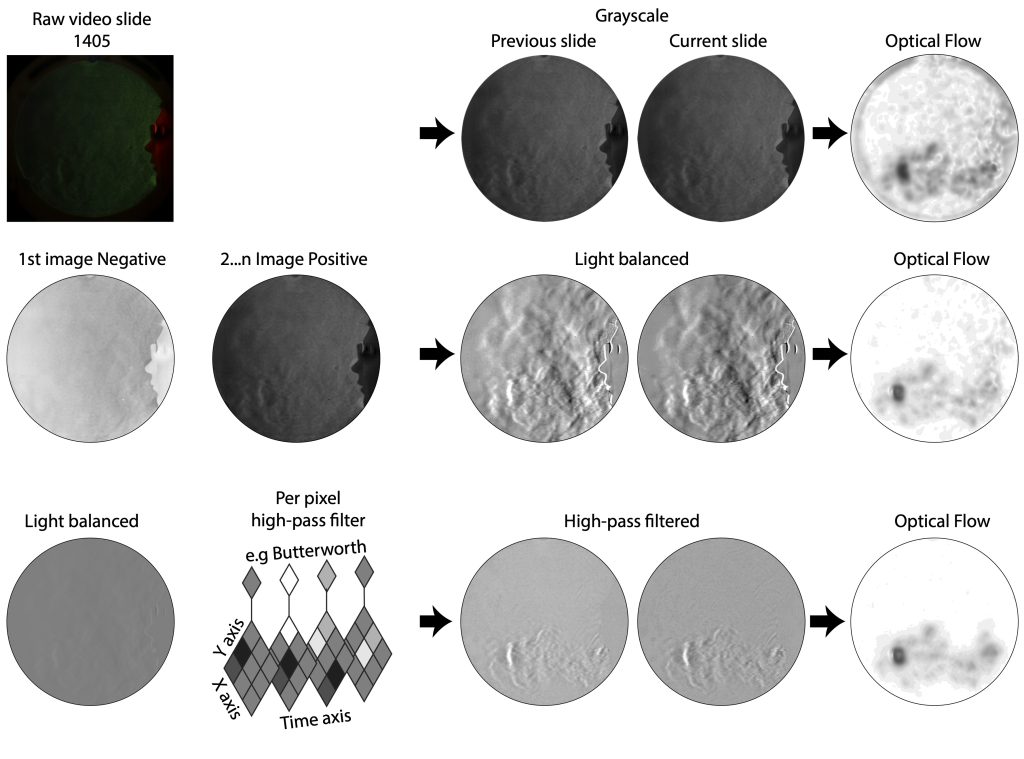
Mark Jermy, Jason Chen and I published an article in Scientific Reports on “Isolating fast and slow flows in three-dimensional fluid dynamics”. This article describes a process for separating fast and slow flow changes from each other in any transparent flow visualized along the same plane. We used it to remove buoyancy-based information from speech airflow outside the mouth, and this allows much more appropriate optical flow field analysis, as you can see in the image below.
Here is the abstract:
“In complex flows where motions at distinctly different speeds co-exist on the same plane, current optical flow (OF) methods preferentially track the slower component due to the small-motion assumption in OF algorithms. We overcome this limitation by balancing light intensity and applying per-pixel time-based high-pass filtering. We demonstrate this method using schlieren video of air motion generated by speech, where fast speech air flow co-exists with slower buoyancy flows from body heat–discrimination impossible with conventional OF. Our method extracted air flow patterns several centimetres from the mouth as a function of spoken sounds, with peak velocities in the English “pa” sound agreeing with CFD simulations. The method allows analysis of spatial and temporal variation in air velocity at distance from the speaker’s lips, made by different sounds (phones). To do this, kymographs (space-time velocity plots) were generated and analysed using Generalized Additive Mixed-effect Models (GAMM). At 30 cm from the lips, statistical models showed higher predictive power (: 2.64%7.57%), reduced complexity, and improved fit (fREML: 6.8E77.3E6, 89.3% residual reduction) compared to uncorrected data. The method is generalizable to any 3D optically accessible flow with motion predominantly in the image plane containing co-located high and low speed motions.”